
Let’s talk about design, ideas, memes, or vibes. Bonus points for “design hot takes” and “good playlist” recommendations.

© Naman Jain 2026

Let’s talk about design, ideas, memes, or vibes. Bonus points for “design hot takes” and “good playlist” recommendations.

© Naman Jain 2026

Let’s talk about design, ideas, memes, or vibes. Bonus points for “design hot takes” and “good playlist” recommendations.

© Naman Jain 2026Italy
Mix A Pixel physical RGB colour-mixing device

Mix A Pixel

Mix A Pixel

Mix A Pixel

Mix A Pixel is a hands-on learning artefact that introduces children to the red, green and blue light behind every digital screen. Developed for a Physical Computing course, it turns RGB from a static diagram into something children can manipulate: three physical sliders set values from 0 to 255, and the colour on screen changes instantly.

Children begin with a reference colour and experiment until they recreate it. When the match is close, pressing a button lights every LED-matrix pixel that uses that colour. Repeating the challenge gradually reveals a complete image. Through play, children see how RGB values set the colour of individual pixels and how those pixels form the image on a screen.

INSTITUTION

Copenhagen Institute of Interaction Design

COURSE

Physical Computing

DURATION

2 weeks

GROUP PROJECT

Diana Chaves Naman Jain Kabir Shrivastava

Mix A Pixel is a hands-on learning artefact that introduces children to the red, green and blue light behind every digital screen. Developed for a Physical Computing course, it turns RGB from a static diagram into something children can manipulate: three physical sliders set values from 0 to 255, and the colour on screen changes instantly.

Children begin with a reference colour and experiment until they recreate it. When the match is close, pressing a button lights every LED-matrix pixel that uses that colour. Repeating the challenge gradually reveals a complete image. Through play, children see how RGB values set the colour of individual pixels and how those pixels form the image on a screen.

INSTITUTION

Copenhagen Institute of Interaction Design

COURSE

Physical Computing

DURATION

2 weeks

GROUP PROJECT

Diana Chaves Naman Jain Kabir Shrivastava

Mix A Pixel is a hands-on learning artefact that introduces children to the red, green and blue light behind every digital screen. Developed for a Physical Computing course, it turns RGB from a static diagram into something children can manipulate: three physical sliders set values from 0 to 255, and the colour on screen changes instantly.

Children begin with a reference colour and experiment until they recreate it. When the match is close, pressing a button lights every LED-matrix pixel that uses that colour. Repeating the challenge gradually reveals a complete image. Through play, children see how RGB values set the colour of individual pixels and how those pixels form the image on a screen.

INSTITUTION

Copenhagen Institute of Interaction Design

COURSE

Physical Computing

DURATION

2 weeks

GROUP PROJECT

Diana Chaves Naman Jain Kabir Shrivastava

A SCREEN IS MADE OF LIGHT

RGB becomes a physical experiment

The object puts the red, green and blue light of a screen into children’s hands. The interaction starts with a colour they can change, not with a diagram.

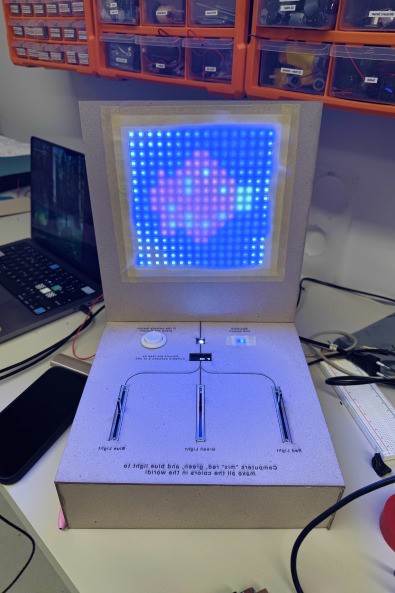
The Mix A Pixel box: an LED grid above red, green and blue light sliders, with the line “Computers ‘mix’ red, green, and blue light to make all the colors in the world!”
A visitor presses Mix A Pixel’s buttons beside its lit screen at an exhibition table
An earlier white Mix A Pixel prototype with a glowing LED grid and three sliders

MIX WITH YOUR HANDS

Three sliders make the values visible

Physical controls set red, green and blue values from 0 to 255. Every adjustment updates the mixed colour on the display in real time, linking a numeric value to an immediate visual result.

A SCREEN IS MADE OF LIGHT

RGB becomes a physical experiment

The object puts the red, green and blue light of a screen into children’s hands. The interaction starts with a colour they can change, not with a diagram.

The Mix A Pixel box: an LED grid above red, green and blue light sliders, with the line “Computers ‘mix’ red, green, and blue light to make all the colors in the world!”
A visitor presses Mix A Pixel’s buttons beside its lit screen at an exhibition table
An earlier white Mix A Pixel prototype with a glowing LED grid and three sliders

MIX WITH YOUR HANDS

Three sliders make the values visible

Physical controls set red, green and blue values from 0 to 255. Every adjustment updates the mixed colour on the display in real time, linking a numeric value to an immediate visual result.

A SCREEN IS MADE OF LIGHT

RGB becomes a physical experiment

The object puts the red, green and blue light of a screen into children’s hands. The interaction starts with a colour they can change, not with a diagram.

The Mix A Pixel box: an LED grid above red, green and blue light sliders, with the line “Computers ‘mix’ red, green, and blue light to make all the colors in the world!”
A visitor presses Mix A Pixel’s buttons beside its lit screen at an exhibition table
An earlier white Mix A Pixel prototype with a glowing LED grid and three sliders

MIX WITH YOUR HANDS

Three sliders make the values visible

Physical controls set red, green and blue values from 0 to 255. Every adjustment updates the mixed colour on the display in real time, linking a numeric value to an immediate visual result.

THE BUILD

The parts behind the colour

An Arduino R4 coordinates the interaction while three potentiometer sliders set the red, green and blue values. The LCD makes those numbers visible, and the arcade button, two indicator LEDs and LED matrix turn each match into feedback children can see.

Horizontal top-down technical illustration of Mix A Pixel components: Arduino R4, LED matrix, three slider controls, LCD, arcade button, and two LEDs.

Arduino R4

LED matrix

Potentiometer sliders

LCD screen

Button + LEDs

Arduino R4

LED matrix

Potentiometer sliders

LCD screen

Button + LEDs

MATCH THE REFERENCE

Experiment before the answer is given

A reference colour creates a small challenge: move the three controls until the displayed mix comes close. Colour matching becomes something children can explore again and again, instead of a static explanation.
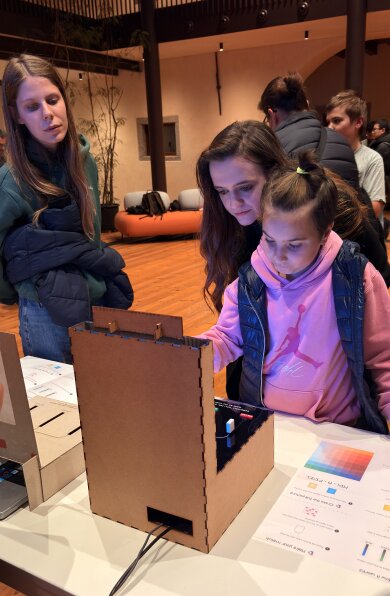
A child explores the Mix A Pixel prototype with an adult.
Visitors lean in to try Mix A Pixel’s controls
Visitors explore Mix A Pixel’s controls and colour references.
Children and adults use the Mix A Pixel prototype together.

REVEAL THE PIXELS

Small matches build a larger image

When a close match is achieved, a button activates the LED matrix and lights the pixels that use that colour. Repeating the process with new reference colours gradually reveals the complete image.
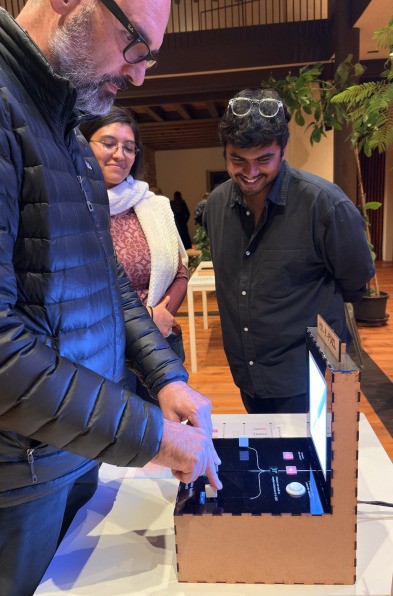
A visitor presses Mix A Pixel’s buttons while two others watch and smile
Two visitors bend over Mix A Pixel’s controls
A visitor moves a Mix A Pixel slider while another smiles

REFLECTION

An abstract screen system becomes something to play with

Mix A Pixel keeps RGB colour in the hands: adjust a value, see the change, then connect that one match to a larger image. The object turns a technical building block into a sequence of small discoveries.
A child explores the Mix A Pixel prototype with an adult.
A phone screen under a microscope, its red, green and blue subpixels magnified on the monitor above
A person tests a paper layout of three sliders at a workbench
Two visitors lean over the Mix A Pixel box at the exhibition table
Electronics on a workbench: an LED grid, a breadboard, an Arduino board and wiring
Printed sketches and storyboards laid out on a table
Visitors talk beside the Mix A Pixel table at the exhibition
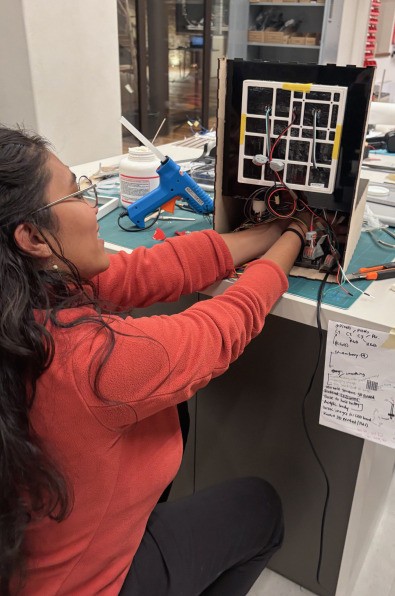
A person wires a gridded LED panel inside a black box at a workbench
Two people pull faces for the camera while holding a black prototype box and a glue gun
A child explores the Mix A Pixel prototype with an adult.
Visitors talk beside the Mix A Pixel table at the exhibition
Electronics on a workbench: an LED grid, a breadboard, an Arduino board and wiring
A person tests a paper layout of three sliders at a workbench
Two people pull faces for the camera while holding a black prototype box and a glue gun
Two visitors lean over the Mix A Pixel box at the exhibition table
A phone screen under a microscope, its red, green and blue subpixels magnified on the monitor above
A person wires a gridded LED panel inside a black box at a workbench
Printed sketches and storyboards laid out on a table
Next up

Next up

Next up